From 22 to 24 April 2026, SUBMON attended the 37th Annual Conference of the European Cetacean Society (ECS), held in Dundee, Scotland, under the theme “Basics to Benefits”.
With nearly 800 attendees, ECS 2026 became the most widely attended conference in the Society’s history, further establishing itself as one of the leading meeting points for the European scientific community dedicated to cetacean research. This edition highlighted the full journey of marine mammal science, from fundamental research that generates knowledge to applied studies that translate this knowledge into conservation and management measures.
A pre-conference workshop on drones for marine mammal research
Before the official start of the conference, SUBMON attended the workshop “Flying Forward: Innovations, Ethics, and Best Practices for Unmanned Aerial Vehicles in Marine Mammal Research”. The workshop explored the different applications of unmanned aerial vehicles (UAVs) in marine mammal research, as well as the scientific strengths and limitations of each application, the potential levels of disturbance to animals and the methodological trade-offs involved in decisions such as flight altitude, flight duration and disturbance mitigation. Through short presentations and open discussions, the workshop provided an opportunity to exchange knowledge, identify shared needs and explore best practices across European research teams.
The workshop was particularly relevant to the work SUBMON is carrying out within the COSTtERA-3 project, where drones equipped with LiDAR technology are used to obtain non-invasive biometric measurements of bottlenose dolphins (Tursiops truncatus) and assess their body condition. COSTtERA-3 is being implemented with the support of the Fundación Biodiversidad of the Spanish Ministry for the Ecological Transition and the Demographic Challenge through the Pleamar Programme, and is co-funded by the European Union through EMFAF (European Maritime, Fisheries and Aquaculture Fund).
Throughout the conference, the SUBMON team presented two posters showcasing part of the work carried out within COSTtERA: the observation of a case not previously described in the Mediterranean and the development of artificial intelligence tools to analyse images obtained during monitoring activities.

Natàlia Amigó and Carla Álvarez Chicote during ECS 2026 in Dundee, Scotland. Photo credits: SUBMON.
A presumed Risso’s dolphin calf among bottlenose dolphins: an unusual sighting in Cap de Creus
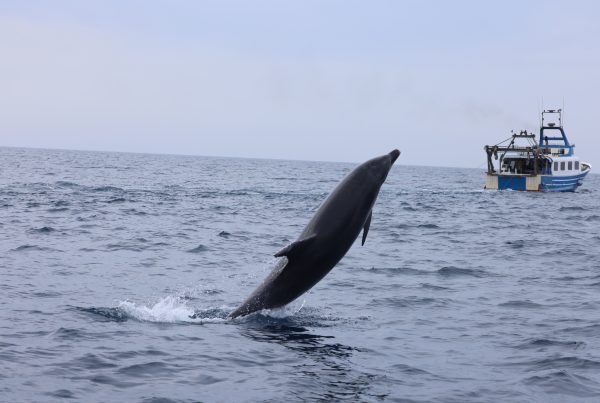
One of the studies presented by SUBMON was the poster “A Puzzling Calf: First record of an association between a presumed Grampus griseus calf and an adult Tursiops truncatus in the Mediterranean Sea”, presented by Natàlia Amigó. The study documents a sighting recorded in the waters of Cap de Creus, in north-eastern Catalonia, during one of the regular COSTtERA field surveys, in which a calf showing characteristic features of a Risso’s dolphin was observed alongside a group of bottlenose dolphins following a trawling vessel.
This observation raises several possible interpretations. It could represent a case of interspecific alloparental care, in which a female bottlenose dolphin is caring for a Risso’s dolphin calf, or a case of hybridisation between the two species. The available morphological evidence more strongly supports the first hypothesis, although hybridisation cannot be ruled out in the absence of genetic confirmation. In any case, this is the first documented record in the Mediterranean of an association of this kind between these two species. The observation provides valuable insights into the social flexibility of dolphins and the spatial overlap between species that usually display different habitat preferences.

Natàlia Amigó during the poster session at ECS 2026 in Dundee, Scotland. Photo credits: SUBMON.
Automatic bottlenose dolphin detection using artificial intelligence
Carla A. Chicote also presented the poster “Automatic image-based detection of bottlenose dolphins in trawl net monitoring cameras”. This work addresses one of the main challenges in monitoring dolphin interactions with trawl fisheries: analysing the enormous volume of underwater video generated by cameras installed in fishing nets. The team trained artificial intelligence models based on the YOLOv8 architecture to automatically detect the presence of bottlenose dolphins in images with varying quality and visibility.
The model showed robust performance even under challenging underwater conditions, confirming the potential of artificial intelligence as a tool to support the monitoring of bottlenose dolphins interacting with trawl fisheries. In addition to reducing the time required to manually review recordings, these systems pave the way for faster and more accurate analyses of the species’ behaviour. This work builds on the artificial intelligence research developed in COSTtERA-2 and contributes to the methodological objectives of COSTtERA-3.

Carla Álvarez Chicote during the poster session at ECS 2026 in Dundee. Photo credits: SUBMON.
ECS 2026, the largest European cetacean conference ever held
In its most attended edition to date, ECS 2026 provided SUBMON with an excellent opportunity to share results, compare methodologies and establish new collaborations with European research groups working on related topics.