


The BiodivOcean team recently gathered in Gothenburg, Sweden, for the project’s Annual Meeting. As a partner in BiodivOcean, SUBMON joined the project consortium for several days of project updates, planning and collaborative work, including the development of one of the project’s key educational resources: the upcoming BiodivOcean MOOC.
The course is being developed to provide teachers and educators with practical tools, guidance and inspiration to bring Ocean Literacy and the VIRTUE methodology into the classroom. During our days in Sweden, we worked alongside our BiodivOcean partners, including the University of Gothenburg and the Gothenburg Marine Biological Laboratory (GMBL), to record new audiovisual material for the course and explore different approaches to engaging people with marine biodiversity.
Taking VIRTUE into the field
Part of the filming took place on Vrångö, an island in the Gothenburg archipelago. Equipped with cameras, sampling materials and an ROV (Remotely Operated Vehicle), the team recorded different aspects of the VIRTUE methodology and its use for exploring marine biodiversity.
VIRTUE uses simple structures fitted with discs that are submerged in the sea, where marine organisms can settle and grow. Once retrieved, the discs become small observation platforms that allow participants to investigate the diversity of organisms living in their local marine environment.

VIRTUE discs after being retrieved from the sea, covered by marine organisms that settled on them during deployment. Credits: Juanita Zorrilla-Pujana-SUBMON.
The footage recorded on Vrångö will become part of the BiodivOcean MOOC, helping teachers understand how to apply the methodology and use it as a practical tool for marine environmental education.
Discovering the biodiversity of a 20 cm disc
Back at the GMBL laboratory, we had the opportunity to examine VIRTUE discs and identify some of the organisms that had colonised them.
Using microscopes, identification guides and tools for capturing high-resolution photographs and videos, we observed bryozoans, small sea stars, mussels, tunicates and barnacles, among many other organisms.
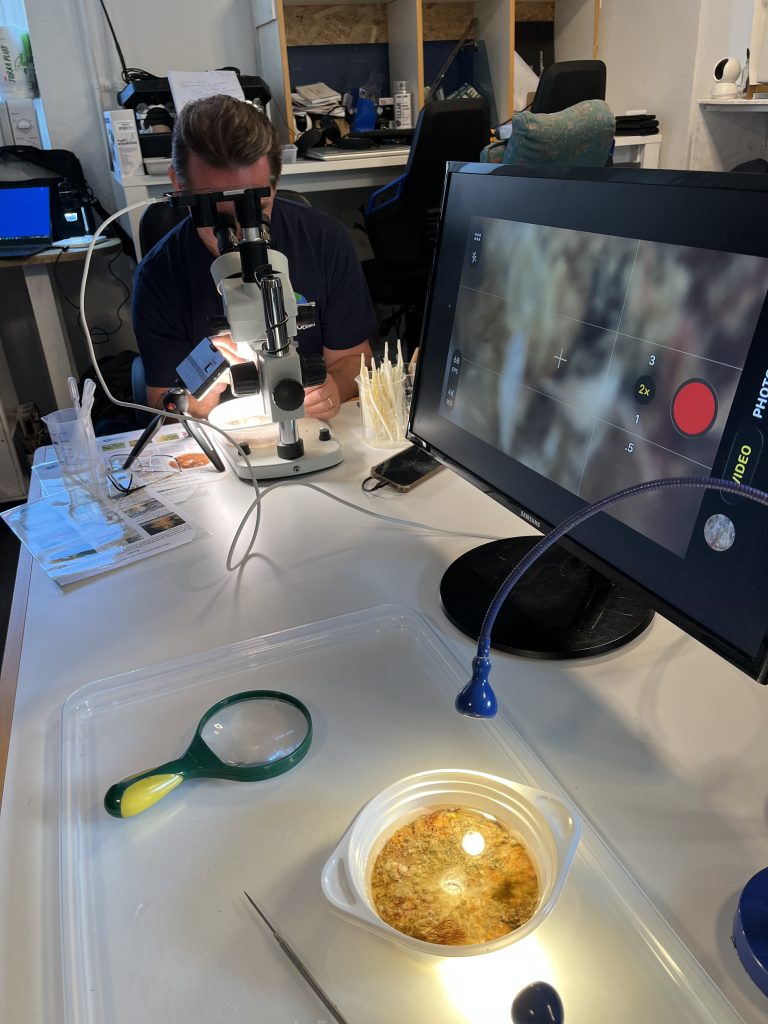
Exploring the biodiversity found on VIRTUE discs at the Gothenburg Marine Biological Laboratory (GMBL). Credits: Juanita Zorrilla-Pujana SUBMON.
The experience illustrated one of the ideas behind BiodivOcean: meaningful encounters with marine biodiversity do not necessarily require travelling to remote environments or observing large marine species. A 20 cm disc can reveal a surprisingly diverse community and provide an accessible way to spark curiosity about the ocean.
This sense of discovery —the project’s “WOW effect”— is also what BiodivOcean aims to bring into classrooms through the VIRTUE methodology.
Connecting people with marine science
The programme also included a visit to Flytevi, in Frihamnen, at the University of Gothenburg’s Centre for Sea and Society. The space offers citizens opportunities to explore and experiment with marine science within the city, providing another example of how direct experiences can make the ocean and marine research more accessible.
The team also visited the Gothenburg Aquarium, where we met with Ocean Literacy experts and discussed different ways of engaging citizens with the ocean and marine research.
The exchange focused on questions that are central to the development of the BiodivOcean MOOC: how can marine science education become more experimental and engaging? And how can we move beyond simply communicating knowledge to create experiences that encourage people to observe, ask questions and discover more about the ocean?
The meeting concluded with a tasting of products made from sugar kelp, offering yet another way of exploring our relationship with the marine environment.
After several days of filming, observing, experimenting and exchanging ideas, the BiodivOcean MOOC is now one step closer to becoming a reality. The next stage will be to transform the material gathered in Gothenburg into practical resources that teachers can use to bring marine biodiversity and Ocean Literacy into their classrooms.
Sometimes, discovering an entire world of marine biodiversity can start with something as simple as a 20 cm disc and the curiosity to look closer.
Stay tuned: the BiodivOcean MOOC is on its way!


